
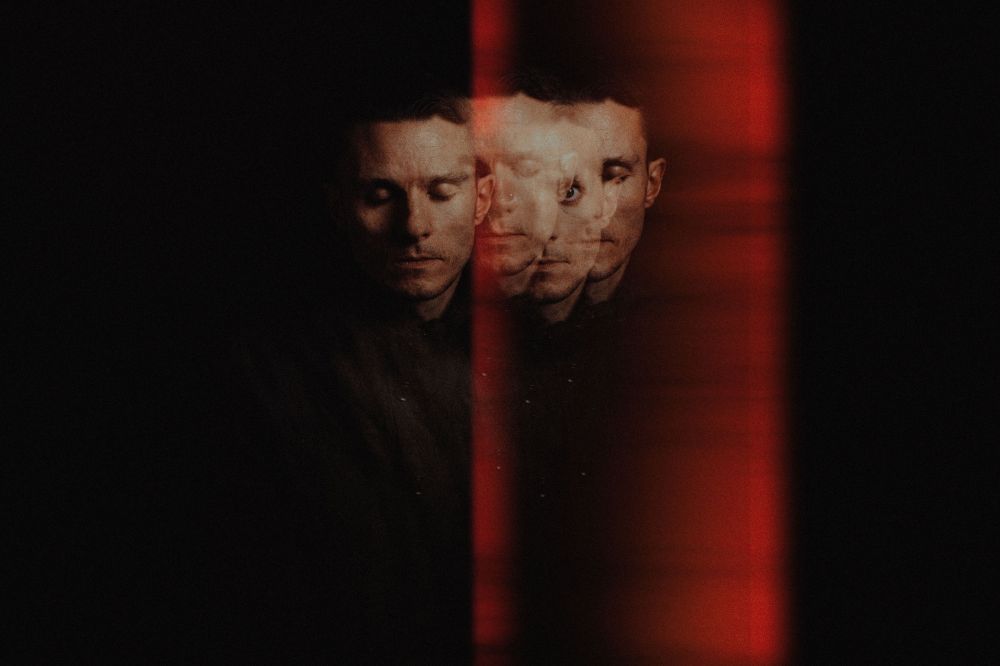
At the end of last year, we gained a new Affin colleague in rhubiqs. The London-based artist has delivered an exceptional album with ‘Aegis Of Silence’, reason enough to delve a little deeper…
J: When you look back on your debut album, what has changed since then in your musical direction/development and also your approach?
r: It’s kind of crazy when I look back on my earliest releases and compare them to where I’m at now. Firstly, I’d say my production, mixing and overall engineering skills are much improved. The music I create these days stands up in terms of production quality, although perhaps that is my bias coming through. When I listen back to my first album I hear a lot of interesting + exciting ideas with flaws in the execution when it comes to that “professional sound”.
I’d also say that these days I am far more ambitious and operate under fewer artificial constraints. I have the confidence to create + release the music that resonates most with me which happens to be experimental in nature. In the early days I think I felt this self-imposed constraint to create music that’s a bit more digestible to the average listener by including things like percussion, obvious time signatures, bridges into drops, etc. Following a more typical musical structure as heard in the mainstream, if you will. I did always create more experimental tracks (see ‘Sumburgh Head‘ on Migratory Paths, ‘Saint Wulfstan‘ on the Transatlantic Alliance album) but they were often included as interludes/secondary pieces in those records. Whereas now I have the self-belief to really lean into more experimental aspects – I feel more comfortable in that space and I feel I make better music overall because of that.
J: From a production point of view, is there a tool that you use often? What does your current studio setup look like?
r: Ableton Live is my DAW of choice. I have been using that since 2011 or so. I couldn’t live without it. In terms of creating music itself – I am a huge fan of the various Kompakt VST libraries: I have a lot of packs dedicated to orchestral sounds, pianos, guitars, brass instruments etc. which I often use when making music. If I had to choose one other VST it would be Omnisphere — that is a powerhouse of a plugin with an infinite number of patches which work well in ambient-adjacent music.
I will typically record from those kinds of tools into Ableton and then utilise Ableton’s sampler to manipulate sounds – whether that’s altering pitch, stretching, saturating, etc. I used a lot of the Isotope Trash plugin on Aegis of Silence to get that gritty/saturated feel around the edges of the songs. I don’t tend to use “real” instruments so much these days, although occasionally I will do so.
J: Your album “Aegis Of Silence” sounds very mature and stands on its own musically. Can you tell us a little about the creation process?
r: I never set out to make a full album from the start. At the time, I was deeply immersed in the work of tape-based artists like William Basinski and Taylor Deupree, and I wanted to explore their recording techniques, which I hadn’t experimented with before. I didn’t have access to actual tape machines, but I was able to simulate similar processes in Ableton, using loops of samples played in reverse, forward, and at varying speeds across multiple channels. This approach reminded me a lot of Brian Eno’s methods from years ago. The first track I created using these techniques was Mistral, which ended up on the album. The result was so satisfying that I continued using this style, which influenced much of the first half of the record.
At one point, I thought about releasing the first four tracks as an EP, as I felt I had explored a lot in that space. Those tracks are fairly dark, and I thought there was room for something more positive. That’s when I decided to shift the mood for track five, Hope’s Canvas, bringing a more uplifting and optimistic tone to the album.
Tomorrow’s Dawn started as a piano piece I had been working on for a while, but I wasn’t sure where it was headed. I tried adding pads and orchestral layers, and I considered making it longer, but in the end, I simplified it by stripping away everything except the felt piano. The result is a shorter, purer piece that I think works perfectly as an interlude, dividing the two halves of the album. It’s a reminder that sometimes less is more.
Two tracks on the album are collaborations. Sleep // Forget features my good friend Robert Farrugia, a brilliant ambient artist (Phantom Limb, ROHS!, and more). I had always wanted to work with him, so I sent him a rough demo. He came back with a fully fleshed-out version that became the track on the album. Crazy! His contribution adds a lot of depth to the record, and I’m really pleased with how it fits in alongside the other solo-produced tracks.
Amongst the Gods II originally started as a remix I did for the post-rock band Oldernar from Staffordshire. For various reasons—life changes like babies, moving houses, and job shifts—we never managed to release it. However, Nick from the band kindly let me use it for this album. It fits really well between Reverie In Bloom // VII.VI.MMXXI and Resolved, adding a nice transition and contrast to the overall flow of the record.
J: How has your surroundings in London influenced you musically? Is there anything that you would describe as typical for the UK? Are there many opportunities in the UK for electronic musicians to be able to perform?
r: London has had a massive impact on the music I create. Looking back at my 20s and early 30s, I spent a lot of time soaking in live music there—not just live band shows, but also diving deep into the London club scene. Venues like Fabric and Corsica Studios were spots I often frequented, and the artists I saw perform there have undoubtedly shaped my sound.
When I think about the track Resolved on my album Aegis of Silence, it’s clearly inspired by the production style of Actress, a London-based producer known for his releases on Ninja Tune and other labels. My use of field recordings also owes a lot to Burial, another London-based artist who’s one of my biggest influences. Over the years, I’ve attended countless gigs in the city from promoters like Portals, Cafe Oto, and Baba Yaga’s Hut, who focus on more experimental sounds. That exposure has definitely influenced how I approach making music—I’m always looking to push boundaries and avoid anything too conventional or easy to label.
As for live opportunities – somewhat unsurprisingly there are lots of opportunities in London and the UK. One thing we do consistently well in the UK is create inspiring and genre-defining music. If I think of cities like London, Bristol and Manchester I can point to many music scenes that exploded into genres known worldwide. Those scenes afford plenty of live performance opportunities for new and upcoming electronic musicians.
J: From a personal point of view, what things give you strength to take you away from the hectic pace of life? Are there special activities that you do regularly?
r: As well as music, I am a huge outdoors person. I frequently take long walks and I do a lot of distance running – several days per week, which takes me on to local trails, canals, rivers, etc.; a way to escape urban life and de-stress whilst surrounded by nature. I also love the meditative state that running gives me. Time away from screens, devices + distractions. My mental health for sure benefits. I also love spending time with my wife – Sian – and two children – Sadie & Dylan. Weekends often involve activities with them which fill me with so much joy!
 Joachim Spieth